

Maybe one of you wants to pick the baby up the second she cries and the other wants to wait. Maybe you agreed on a screen rule together and then one of you caved at the first protest. Or you live in two homes now, and bedtime, food and screens all work differently at each. Disagreeing about how to raise your kids can leave both of you feeling judged. It is also very common. Very few parents agree on everything, whether they share a home or not.
Kids don't need two parents who do everything the same way. When parents differ a little, children learn that different people do things differently, and they get practice working out how other people think, including which parent is more likely to say yes to what. Your differences can also balance each other out, as long as you talk them through.
What weighs on kids is conflict that gets loud, scary or disrespectful. Even preschoolers pick up on tension. Seeing parents disagree calmly, listen to each other and explain their reasons can be good for them. Seeing a fight escalate, being sent out of the room, and then waking up to a house where everything seems normal again can leave them confused and unsettled.
Your own warm, steady relationship with your child counts for a great deal, even when the other parent sees things differently.
A very common pattern goes like this. One parent is firmer, with high expectations, and the other is softer and gives more leeway. Each thinks the other is getting it wrong. So the firmer parent gets stricter to make up for the softer one, and the softer parent gets more lenient to make up for the firmer one. Over time you drift further apart, and you end up reacting to each other instead of to what your child needs in that moment.
Naming the pattern together can help. The question to come back to is what your child needs right now, rather than who is right.
- Agree on the big picture first. Talk about what you each want your kids to become, like kind, responsible or able to handle hard things, and what you want discipline to achieve. Smaller rules are easier to settle once you agree on where you are heading.
- Pick the few things you will both hold to every time, and let smaller differences stand.
- Save the hard conversations for later, when you are both calm and the kids are out of earshot. If a disagreement starts heating up in front of them, it is fine to say, "Let's finish this later."
- Get curious about the worry underneath. When one of you digs in hard, there is often a fear behind it. Asking "Tell me more about what worries you here" tends to get further than defending your own position.
- Agree ahead of time how you will hand off. Some parents use a simple signal that means "I'm here to help, go take a break," not "you're doing it wrong." Talk about what happened afterward, once things are calm.
Arguments sometimes get louder than anyone wanted. What helps is repair. Parents often make up after the kids are in bed, so the children saw the fight but never see it settled. Once you two have talked, tell your kids simply and calmly what happened: you disagreed, it got too loud, and you have talked about it. If you said something unkind or scary, say sorry for that part, the same way you would after losing your temper with your child.
Keep it short and suited to your child's age. Kids don't need the details of the disagreement. They need to know the adults are okay and that it isn't theirs to fix.
Disagreeing about parenting is different from someone being hurt. If a parent or caregiver is hurting a child or you, or you fear they might, contact local emergency services (911 in the US) or the Childhelp National Child Abuse Hotline at 1-800-422-4453 (1-800-4-A-CHILD). For domestic violence, call the National Domestic Violence Hotline at 1-800-799-7233. HumanUp is parenting guidance, not crisis care.
- To your partner, once things are calm: "I noticed we handled bedtime really differently tonight. What worries you when I go back in after lights out?"
If it turns into each of you defending your side, stop and ask a bigger question instead, like what you each want bedtime to teach your child. Then try again another evening.
- Handing off in the moment: "Want me to take this one for a bit?"
If the offer lands as criticism, step back for now. Later, ask how your partner would like you to step in next time, so the offer feels like help.
- To your child after an argument they saw: "We got loud earlier, and that might have felt scary. We disagreed, we've talked it through, and we're okay. I'm sorry it got so loud."
If your child keeps asking or seems worried, answer simply each time, and let them see the two of you being kind to each other.
- When you disagree in front of the kids: "We see this one differently. We're going to talk about it later. For tonight, here's what's happening."
If your child keeps pressing for a different answer, keep it short and calm, and stick with tonight's plan.
"Don't listen to them, they're way too strict." Criticizing the other parent to your child puts them in the middle of an adult disagreement. Take the criticism to the other parent, in private.
"Fine, do it your way," followed by quietly doing the opposite later. Making up for the other parent's style can push the two of you further apart.
"Nothing happened, everything's fine," after a fight your child clearly saw. Kids pick up on tension, and being told nothing happened can leave them doubting what they noticed. Say simply what happened and that you are okay now.
Some disagreements carry more heat than the issue seems to deserve. When that happens, it helps to pause and ask yourself what this is really about for you. Often it is a worry, like a fear that your child will be spoiled, a fear for their safety, or a fear that they will grow up scared of a parent.
Sometimes it traces back to how you were raised. Parents can find themselves repeating what their own parents did without thinking, or doing the opposite just as automatically. Naming your own worry out loud gives the other parent something to respond to besides your position, and it often makes the next conversation easier.
You don't have to agree on every parenting decision. What matters here is where the disagreements keep happening and what your child sees when they do.
- What do the two of you disagree about most, like sleep, discipline, screens or food?
- Do you live together, or does your child go back and forth between two homes?
- When you disagree, does it usually happen in front of your child or after they're in bed?
- What did your child see or hear the last time you argued?
- When one of you steps in during a hard moment with your child, how does the other usually react?
Talk it through with Tina Payne Bryson's guidance
Describe the moment you and the other parent keep splitting on, whether you share a home or not. You'll get help choosing what you'll both hold to, what to say to each other and to the kids, and what to try when the plan falls apart, grounded in Tina Payne Bryson's authorized content.
- "My ex lets the kids stay up as late as they want, and I feel like the bad guy. Where do I even start?"
- "We agreed on a bedtime plan, but my partner gives in every time our son pushes back. Now what?"
- "We had a loud fight in front of our 7-year-old last night. What do I say to her today?"
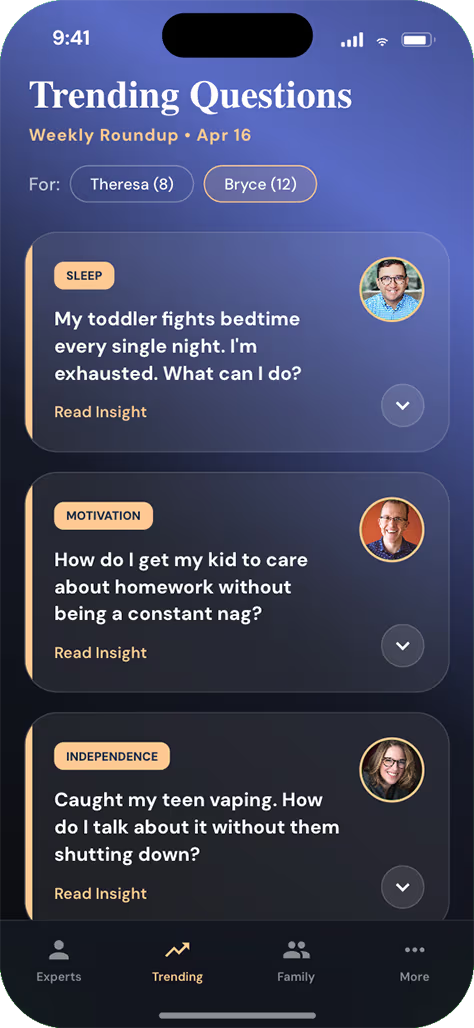


What if your child goes to the other parent every time you say no?
Try HumanUp free on iPhone or iPad. No credit card required.
HumanUp is currently available on iPhone and iPad. Join the Android waitlist for updates.
🔒 Your conversations are never read by a person · Built on trusted expert guidanceFrequently Asked Questions
Not every disagreement. Kids can learn something useful from watching parents disagree calmly, listen and explain their reasons. Loud or harsh arguments are hard on children, even young ones. If things are heating up, pause and finish later. If your kids saw it, let them know you have talked it through.
You don't need to agree on everything, or pretend to. It can be good for kids to see that their parents think about some things differently. What helps is agreeing on the few things that matter most and talking through the rest in private.
You can only change your side. Keep being warm and steady with your child yourself, which counts for a lot. Share what has worked for you as a story rather than a critique, like "I wanted to yell today, but I tried this instead and it went better." If you keep getting stuck on the same issue, a family specialist can help you both think it through.
Not every rule. Children can learn that different homes and different adults do some things differently. What helps is that the adults talk respectfully about the bigger things, and that your child doesn't hear either parent put the other down.
Having a favorite parent for a while is very common, and it often switches. Try not to take it personally. If the preferred parent needs a break, it is okay for the other parent to step in and comfort your child while they are upset about it.