
The meetings are cordial. The emails get answered. Everyone agrees your child is a great kid, and nothing changes. Advocating for a differently wired child inside a school system is a learnable skill, and schools respond to specificity and documentation more reliably than to how clearly or earnestly a parent expresses concern.
Every child is unique, and their developmental journey can significantly impact their school experience. For children with atypical developmental paths, structured environments like schools can pose specific challenges.
These might include sensory sensitivities, social struggles, or learning differences that require individualized attention. The need for advocacy often arises from the mismatch between a child's needs and the school's standard protocols, which don't always accommodate diverse learner profiles.
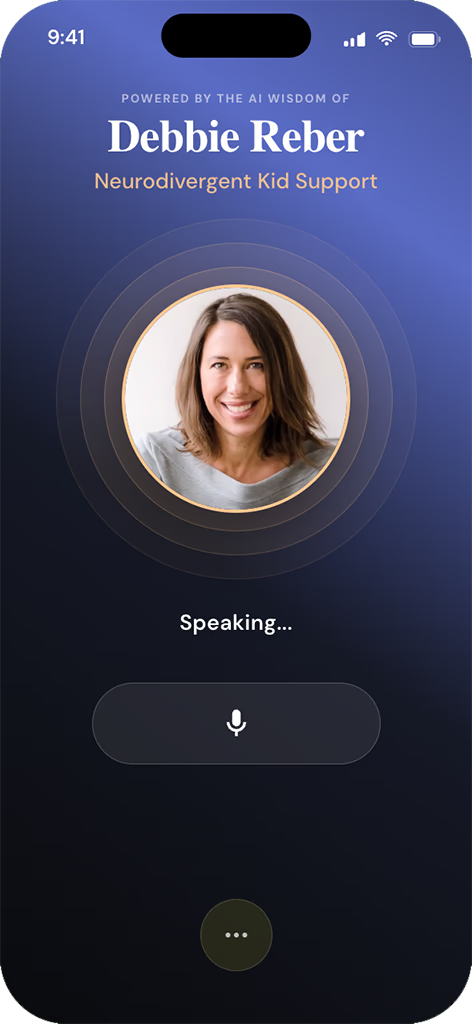
Debbie Reber's philosophy emphasizes the importance of viewing these differences not as deficits but as unique strengths. By understanding your child's specific developmental profile, you can more effectively communicate their needs to educators. This perspective shifts the narrative from 'fixing' the child to supporting an environment that recognizes and nurtures their individual learning style.
In elementary school (K–5), parents carry most of the advocacy weight: the goal is getting the right documentation in place early, because early identification shapes every subsequent support decision. Middle school (grades 6–8) is when coordination gets harder: the team expands, the schedule fragments, and the work of connecting what's in the IEP to what actually happens across six different classrooms often falls to parents by default.
In high school (grades 9–12), effective advocacy includes beginning to transfer self-advocacy skills to the student: a teenager who enters college or employment without the ability to name what they need is a gap that the IEP years should have been closing.
- Collaborative Language: "I'm eager to work together to find the best approach for [Child's Name]."
If collaboration is met with resistance, consider suggesting a meeting to brainstorm solutions, emphasizing shared goals for the child's success.
- Empathy and Understanding: "I understand the challenges teachers face; how can we support each other?"
If empathy doesn't break the ice, try redirecting the conversation to focus on specific, actionable steps that can be taken.
- Highlighting Strengths: "[Child's Name] excels in [Specific Area]; how can we leverage this in learning?"
If this approach stalls, suggest a trial period for a strength-based strategy to demonstrate its effectiveness.
Avoid saying, "I just don't think you're meeting my child's needs." This can create a defensive atmosphere rather than a cooperative one. Instead, express your concerns as shared goals. Additionally, refrain from stating, "You just don't understand my child." This can lead to breakdowns in communication. Aim to educate and inform instead.
Arriving at an IEP meeting without a written list of concerns means the school's framing drives the conversation. Treating every meeting as a collaborative partnership when legal rights need to be asserted creates a politeness dynamic that can work against the child.
Not understanding the legal framework: that FAPE (Free Appropriate Public Education) is a legal standard, not a discretionary offering: means advocating without the most important leverage available. The habit that changes outcomes: after any verbal conversation with a school official, send a brief follow-up email confirming what was discussed and what was agreed. This builds a paper trail without confrontation.
The baseline guidance above is useful on its own. The details below can change where it makes sense to start, how much support to add, or when to involve someone else.
- How old is your child, and what developmental stage are they in?
- What exactly happens before, during, and after the school problem?
- Is this new, or has the pattern been building over time?
- What does your child say is the hardest part?
- What has the teacher or school noticed, and what has already been tried?
Frequently Asked Questions
Begin by gathering information about your child's needs and how they're currently being addressed. Prepare to discuss specific examples with educators and focus on collaborative solutions.
If your concerns are not being addressed, consider requesting a formal meeting with the school's special education team or seeking outside resources such as an educational advocate.
Frame your communication around partnership and shared goals for your child's success. Use positive language and highlight the strengths your child brings to the classroom.