

The minutes right after a youth sports event are easy to underestimate. The game is over. The equipment is packed. Your child gets in the car, and whatever just happened on that field floods back in, all at once, with nowhere to go. If she played well and the team lost, it's heartbreak. If she played poorly and the team won, it's a private shame that doesn't even get to grieve out loud. And if she played poorly and the team lost, you're sitting next to a completely overwhelmed child who may not have the words yet to tell you what's wrong.
What happens in that car, on the walk to the parking lot or at the snack table right after can shape how your child handles disappointment, and how they feel about playing.
Right after a game, many kids can't take in much of what you say, good or bad. What they pick up is your tone. Are you frustrated with how they played? Relieved it's over? Ready to analyze? Kids notice all of that before you've finished your first sentence.
What tends to work is disarmingly simple, and it is a line sports parents have passed around for years: "I love watching you play." That's it. No qualifier, no "even though," no immediate pivot to what comes next. Five words that tell your child: I was watching, I care, and how much I care doesn't depend on the scoreboard.
The reason so little is needed in that moment is that the game is not the point. Kirsten Jones, who played Division I volleyball and spent almost 15 years at Nike, puts the long view this way: “I don’t need my kid to be the star, but I want them to know that the life lessons they learn through that experience—at whatever age the ball stops bouncing—they can apply those lessons to whatever they choose to do next.”
What not to say in the first five minutes:
- "You played great!": This is evaluation, and they know if it's true. If they played poorly, it lands as condescension, not comfort.
- "What happened out there?" : Analysis, and they aren't ready for it yet.
- "The ref was terrible.": Externalization teaches them that outcomes come from factors outside their control, which is the opposite of the mental model you're building toward.
- "You'll get 'em next time.": Future-oriented, which skips right over the present emotion without acknowledging it.
- Silence that communicates disappointment.: Kids are exquisitely sensitive to parental emotional states. Silence that comes from you trying to hold back frustration reads very differently from silence that communicates "I'm here and you're okay."
Competition asks a lot of a child: holding it together and staying focused for a long stretch, often in front of people they want to impress. When it ends, everything they held in can come out at once, in the first place it feels safe to.
Often a post-game crash is intense but brief. The child sobbing in the parking lot is often fine by dinner. That changes what the moment asks of you. Not intervention, not problem-solving, not a conversation about feelings. Just presence.
Age changes what the crash looks like. Younger kids often cry hard and recover fast. Around the middle school years, some kids get embarrassed that they got upset, which can add a second layer to it. Teenagers often go quiet instead: silence, irritability, a closed door. Then your job is keeping the door open for a conversation that may happen hours later, or the next day.
There is a time for the game conversation. It's just not the car ride. The debrief that works is the one your child brings up, and where you respond with questions rather than analysis. That often happens once the strong feelings have passed: at dinner, over a snack when you're side by side rather than face-to-face, or at bedtime.
The questions that open rather than close:
- "What part felt best to you?" (before anything about what didn't go well)
- "What do you wish you'd had more time to work on?"
- "Is there anything you want to do differently next practice?"
The question that closes: "What went wrong?" That's a coaching question in a parenting moment, and kids hear the evaluation in it even when it isn't intended.
Critically: you don't always need to debrief. A good post-game meal, a return to normal family rhythm, and no mention of the game at all is a completely legitimate approach. Kids learn through that too: that the game was a game, not a referendum on their worth. The absence of mandatory processing is itself a message about proportion.
When It Lasts Beyond the Game If the hard feelings keep spilling well past game day, have a calm conversation away from the sport about how it feels to your child right now and what they want from it. If anything about your child's health or development worries you, your pediatrician is the right person to ask.Giving a child space to cool off after a game, before any review, often helps most. How long the upset lasts, and what sets it off, shapes what you say next.
- Does your child fall apart only after losses, or also after wins when they felt they played badly?
- Is it over by dinner, or still hanging over your child at bedtime and the next day?
- Is the ride home usually quiet, filled with music, or spent talking about the game?
- Does your child ask for your take on the game, or does it usually come unasked?
- Do you know this sport well from playing it yourself?
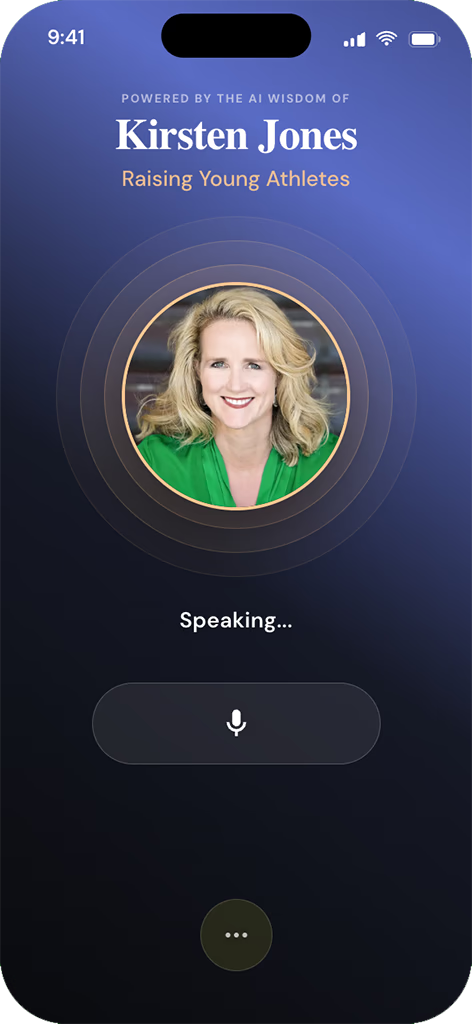
Talk it through with Kirsten Jones's guidance
Bring the game that ended badly, or the one coming up this weekend. You can plan the first few minutes after the game, when to talk about it and what to do if the ride home keeps going badly, with guidance grounded in Kirsten Jones's authorized content.
- “My 9-year-old sobs after every loss and is fine an hour later. Where do I start?”
- “I've stopped talking about the game in the car, but my 14-year-old still shuts down for the whole evening. What now?”
- “My son is angry at himself even after his team wins if he made an error. What do I say on the way home?”

What if your child wants to talk through every play on the drive home?
Try HumanUp free on iPhone or iPad. No credit card required.
HumanUp is currently available on iPhone and iPad. Join the Android waitlist for updates.
🔒 Your conversations are never read by a person · Built on trusted expert guidanceFrequently Asked Questions
Often the most helpful thing is the least: "I love watching you play." Right after a loss, many kids aren't ready for feedback, analysis or even reassurance. What they notice is whether you're on their side. A quiet car can feel like acceptance to them, even when it feels uncomfortable to you.
Post-game crashes aren't only about losing. A close game, a run-in with a teammate, or not playing the way they hoped can all set one off. Often it's the intensity of the game, not the score, that your child is coming down from.
The conversation your child is actually ready for usually comes a few hours later: often at dinner or bedtime, when the heat is out of it. The tell that they're ready is when they bring it up. If they want to process the game, they will; your job is to be available and non-evaluative when they do. Starting the debrief yourself, especially in the car, often comes across as criticism, however gently you put it.
Post-game meltdowns on their own aren't necessarily a reason to quit. What matters more is the bigger picture: do they enjoy practice, do they want to go, and what do they say they want from the sport? If they want to stop, finishing the season they signed up for is often worth it, unless something isn't right or safe.