
You've tried the quiet room, sitting alongside her, bribes, consequences, and the patient explanation of why school matters. Sometimes something works for a week and then stops working, and you're back at the same kitchen table standoff. Before you add another strategy to the pile, it's worth understanding what's actually happening in your child's brain, because the tools that work for neurotypical kids don't just underperform here, they often actively backfire.
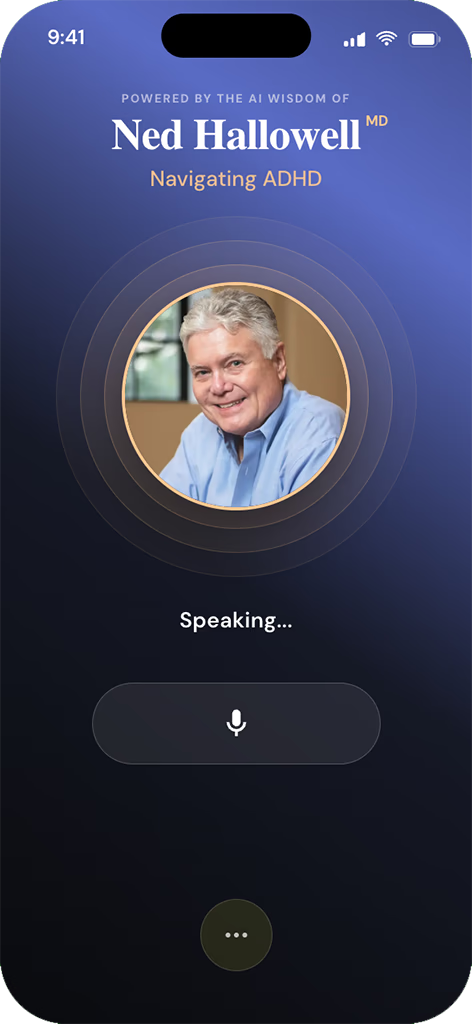
Children with ADHD often experience difficulty focusing due to inherent neurological differences. According to Dr. Ned Hallowell, ADHD can be seen as a brain that processes information differently, often leading to challenges in attention regulation. This isn't due to a lack of effort or motivation but is deeply rooted in how their brains function.
ADHD is often accompanied by a unique blend of cognitive traits, including a high level of distractibility and an inability to filter out extraneous stimuli. This neurological setup can make it hard for children to sustain attention on uninteresting tasks. Therefore, it's crucial to approach focus struggles with empathy and understanding, recognizing that the child's brain is wired for novelty and stimulation.
At 6 to 8, focus struggles look like constant movement, interrupting, and tasks that never quite reach completion: most visible in structured settings like homework time or class. By 9 to 12, the pattern is harder to explain away: other kids sit through a 45-minute lesson while your child is still on the first question, yet they can also hyperfocus on a video game for two uninterrupted hours.
In adolescence, the scaffolding that helped in elementary school is largely gone, and teens start managing the gap themselves, often through avoidance, late nights, and a private conviction that something is wrong with them.
- Engage Curiosity: "I wonder what it would be like if we turned this into a game?"
If your child resists, try switching to a different activity that incorporates their interests.
- Break Tasks into Chunks: "Let's focus on just this part for five minutes."
If overwhelmed, reduce the time or offer a small reward for completing each section.
- Use Visual Timers: "Let's set a timer and see how much we can do before it rings."
If the timer causes stress, use it as a countdown to something positive instead.
One common mistake is saying, "Why can't you just focus like everyone else?" This can be damaging as it implies a failure to meet expectations, which can hurt self-esteem.
Avoid saying, "If you don't focus, you'll never succeed." This negative prediction can increase anxiety and reduce motivation. Instead, focus on encouragement and realistic goal setting.
The most common trigger around ADHD focus is the contrast problem: your child just focused intensely on something they chose, and now claims they can't manage ten minutes of homework, and the logical conclusion feels like 'they could do it if they tried.' But the ADHD brain's access to focus isn't a tap that willpower can turn on; it's driven by dopamine availability, which spikes for novelty and interest and crashes for obligation and repetition.
The inconsistency you're witnessing is neurological, not motivational, and that distinction matters for how you respond to it.
The baseline guidance above is useful on its own. The details below can change where it makes sense to start, how much support to add, or when to involve someone else.
- How old is your child, and what developmental stage are they in?
- Does this happen at home, at school, or across settings?
- Is the hard part remembering, getting started, staying focused, or finishing?
- What supports are already in place, and which ones actually help?
- Are ADHD, sleep, anxiety, learning differences, or a recent change part of the picture?
Frequently Asked Questions
Use engaging techniques like gamification, break tasks into smaller parts, and provide visual timers to maintain interest.
Look for patterns of distractibility, difficulty following instructions, and challenges in sustaining attention compared to peers.
Avoid comments that imply they are not trying hard enough or comparing them negatively to others, as these can harm their self-esteem.