
The room has been in the same state for three days. You've mentioned it, your child has said 'I'll do it later,' and later has not come. You know that raising the issue again will end in a standoff you're both tired of, but walking past it one more time while it stays untouched is wearing on you in a way that feels disproportionate to the actual mess.
The exhaustion isn't really about the room. It's about wondering whether the nagging is working at all, and what it means if you stop.
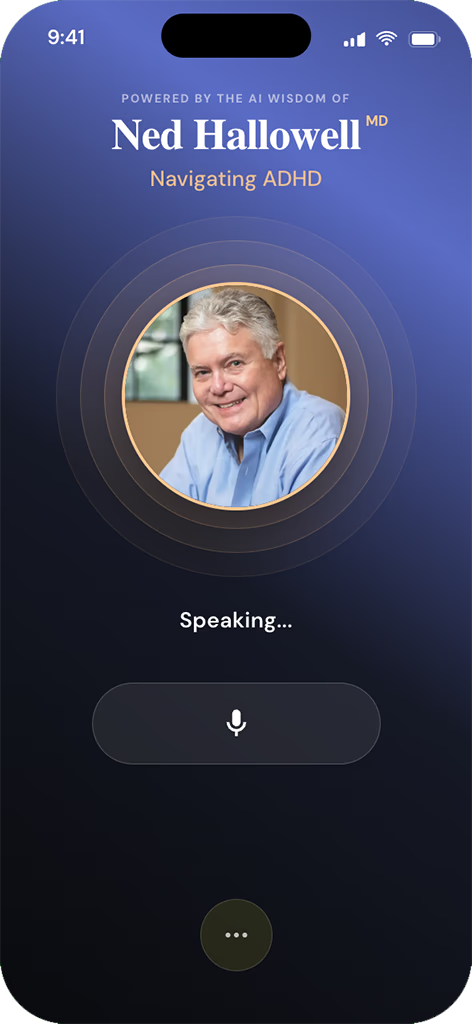
Dr. Ned Hallowell's work illuminates how a child's messy room is often a reflection of their developing executive functions. Children, especially those with characteristics of ADHD, may struggle with organizing their thoughts and actions in a linear manner. This can result in a room that feels like a whirlwind of their internal experiences rather than a neat, orderly space.
Furthermore, children are in the process of developing their own sense of control and autonomy. A messy room can be a form of self-expression, where they exert control in a world that often feels beyond their reach. Realizing that a messy room is not a sign of laziness but a phase in their developmental journey can help parents approach the situation with empathy and understanding.
At 6 to 8, a messy room is often an out-of-sight-out-of-mind reality: the ADHD or EF-challenged brain doesn't register visual disorder the way you do, and the pile of clothes on the floor is genuinely invisible to your child unless they trip over it.
By 10 to 12, the disorganization spreads outward: the backpack becomes a black hole, the desk disappears under papers, and the floor is a holding area for everything without a designated home. By 13 or 14, the disorganization starts looking like a character flaw to teachers and peers who don't understand the underlying EF gap.
- Invite Collaboration: "Let's tackle this together and make it a game!"
If your child refuses, suggest starting with a small area, like a drawer or shelf, to make it manageable.
- Clarify Expectations: "Can we agree on a clear space for your toys?"
If they resist, offer a choice between two areas to give them a sense of control.
- Encourage Ownership: "How would you like to organize your books?"
If they seem overwhelmed, offer to brainstorm ideas together, emphasizing that their input is valuable.
Avoid saying, "Why can't you just clean up?" This can imply that their behavior is a personal failing, rather than a developmental challenge, and may make them feel inadequate.
Refrain from using, "Your room is a disaster!" This can increase feelings of shame and overwhelm, making it harder for them to engage in the cleaning process.
The nagging cycle around organization is particularly draining because it almost never produces lasting change: your child cleans when the pressure gets high enough, the room returns to its previous state within days, and the loop resets.
The deeper frustration is that you can see the system your child needs and they can't: they literally do not perceive the disorder that's obvious to you. Framing it as a perceptual difference rather than a willpower failure ('I notice something you might not be seeing: want me to show you what I mean?') tends to open more doors than another request to 'just clean up.'
The baseline guidance above is useful on its own. The details below can change where it makes sense to start, how much support to add, or when to involve someone else.
- How old is your child, and what developmental stage are they in?
- Does this happen at home, at school, or across settings?
- Is the hard part remembering, getting started, staying focused, or finishing?
- What supports are already in place, and which ones actually help?
- Are ADHD, sleep, anxiety, learning differences, or a recent change part of the picture?
Frequently Asked Questions
Try incorporating fun elements like games or rewards that align with their interests, which can make cleaning feel less like a chore and more like a shared activity.
Validate their feelings and offer a break. Once calm, re-engage with a focus on small, achievable tasks to rebuild momentum.
Allowing some mess can be beneficial for self-expression and creativity. Set basic guidelines for health and safety, but allow flexibility within those boundaries.